


How Nutrition, Energy, and Recovery Support Neuroplasticity
Challenge gives the nervous system a reason to change. But the stimulus is only the beginning. Adaptation also depends on whether the system has the materials, energy, and recovery capacity required to respond.
Challenge Is Only the Beginning
When we think about protecting brain health or improving how the brain performs, most advice eventually turns toward action: exercise, keep learning, practice new skills, challenge balance and coordination, stay socially engaged, manage stress. These things matter because meaningful and appropriately challenging experiences give the nervous system something to respond to.
But creating a challenge is only the beginning. Challenge creates the need for adaptation; it does not guarantee the outcome.
I teach this relationship through a simple model of demand and effective response. Too little demand may leave us under-engaged, with little reason for the system to change. Within a workable range, challenge can increase alertness, attention, and responsiveness while providing enough difficulty to drive adaptation. But when demand exceeds our capacity to respond, the same challenge can become overwhelming rather than productive.
The lesson is not that stress or challenge is bad. In fact, appropriately dosed challenge is essential to adaptation, and stress can be beneficial when it occurs within a range the system can respond to. These experiences are part of how we learn, grow, and expand capacity.
A workout can create a powerful training stimulus, but the body still has to respond and recover. Practice gives the brain new information, but that information still has to be stabilized and integrated. And the same principle extends beyond deliberate training or practice. A difficult season of life can demand adaptation while simultaneously increasing how much the system has to manage.
Peak Insight
Challenge creates the need for change. Capacity shapes the response. More stimulus is not automatically more adaptation.
So alongside asking, “What should I do to improve?”, there is another question worth asking:
What does my brain and body need in order to respond and improve?
Adaptation Has a Biological Cost
Neuroplasticity can sound almost abstract, as though the brain simply decides to “rewire” itself when we practice something often enough. But adaptation is a physical process.
Neurons maintain and remodel cellular structures. Neurotransmitters and other signaling molecules are continually synthesized, released, recycled, and regulated. Cell membranes have to be maintained, and neural signaling requires a continuous supply of energy. Learning and training may begin with an experience, but the biological response requires actual work.
Think of it like renovating a house. Giving a construction crew the renovation order creates a reason for something to change, but the order does not rebuild the house. The crew still needs lumber, wiring, drywall, and other raw materials. They need power and usable energy to do the work. And they need enough time and the right conditions to complete the project.
Biological adaptation follows a similar logic. Challenge creates the demand, but the system still needs raw materials to build with, available energy to do the work, and recovery conditions that allow restoration, consolidation, and remodeling to continue.
That is why a good stimulus does not automatically create a good response. Sometimes greater adaptation requires a better challenge. Sometimes it requires better nourishment or more available energy. And sometimes it requires enough recovery for the system to catch up.
Provide the Raw Materials
If the nervous system is going to maintain itself, communicate effectively, and remodel in response to experience, it needs something to build with.
Protein is usually discussed in the context of muscle, strength, and body composition. Those are important reasons to consume enough of it, especially as we age, but protein’s role extends far beyond skeletal muscle. Dietary protein provides amino acids used throughout the nervous system for cellular maintenance, enzymes, transport proteins, signaling, and neurotransmitter synthesis.
Tyrosine, for example, participates in pathways involved in the production of dopamine and norepinephrine, while tryptophan serves as a precursor within the serotonin pathway. These neurotransmitter systems contribute to attention, motivation, arousal, mood, and learning. Precursor availability is not the only thing regulating these systems, but it can matter. Under certain periods of acute stress or high cognitive demand, supplemental tyrosine has even been studied for its ability to help preserve aspects of cognitive performance. So if you needed another reason to take protein seriously, this is one.
Two other nutrients worth highlighting are choline and DHA. Choline contributes to phospholipid structure and serves as a precursor for acetylcholine, a neurotransmitter with important roles in attention and learning. DHA, an omega-3 fatty acid, is highly concentrated in neural tissue and contributes to the structure and function of neuronal membranes. But these more recognizable “brain nutrients” are only part of the picture. Micronutrients including B vitamins, iron, magnesium, zinc, and others support the many metabolic, enzymatic, and signaling processes the nervous system depends on.
But building an adaptable brain is not simply a matter of collecting individual “brain nutrients.” The brain operates within a larger metabolic and vascular environment, which is one reason broader dietary patterns rich in vegetables, fruits, legumes, nuts, whole grains, fish, and olive oil continue to appear in research on cognitive health.
Rather than trying to memorize every nutrient involved in neuroplasticity, it is more useful to think about how to consistently provide enough high-quality nutritional material for the system to maintain itself and respond to the demands being placed upon it.
I translate that biology into everyday meals through a separate tool called the Adaptable Brain Plate™, which organizes food around four practical functions: Build, Protect, Fuel, and Support.
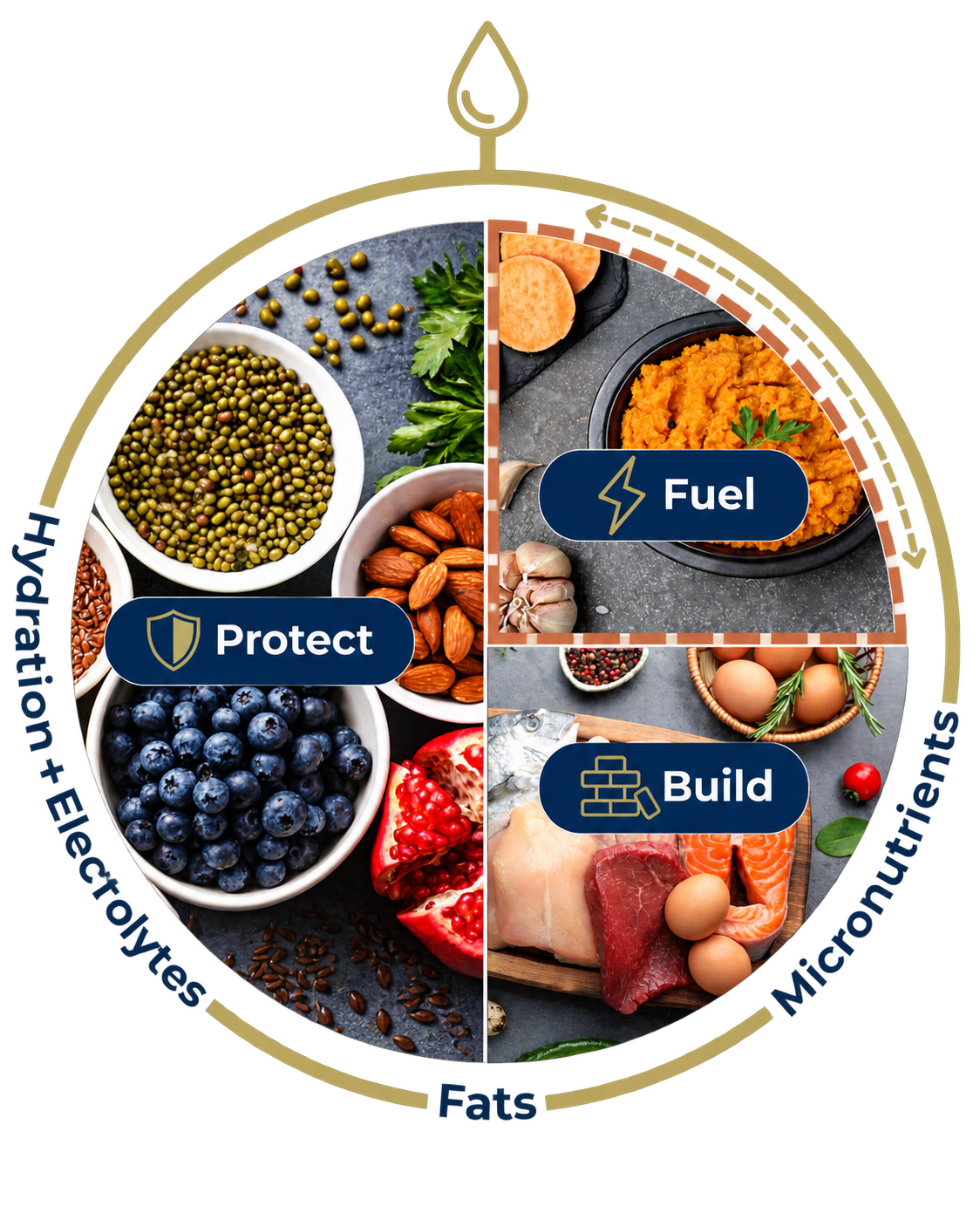
The Plate answers the practical question, “How can I build a meal that supports my brain?” Here, the larger lesson is that before we try to optimize adaptation, we have to give the nervous system something to work with.
Provide Available Energy
Raw materials alone are not enough. The brain also has substantial and continuous energy requirements. Under ordinary mixed-diet conditions, glucose provides much of that energy, but glucose is not the only fuel the brain can use. When ketone availability rises sufficiently, the brain can substantially increase its use of ketones.
That does not make glucose bad or ketones inherently better. The more interesting lesson is that human metabolism is adaptable. Fuel requirements change with what we ask the system to do. A hard training session, a long hike, a sedentary afternoon, and a recovery day do not create identical energy demands, so it makes little sense to assume that fueling has to look exactly the same in every context.
Greater physical demand may call for greater overall energy and carbohydrate availability. Lower-demand periods may require less. This is not about earning carbohydrates or fearing them on rest days. It is about learning to match resources to demand.
Peak Insight
Match fuel to demand. Carbohydrate and total energy needs change with workload. Too little fuel can limit performance and recovery, while chronic excess can undermine metabolic health. The goal is enough energy for the demand in front of you, with the flexibility to adjust as that demand changes.
Why Metabolic Flexibility Matters for the Brain
Research into cognitive decline offers an especially useful window into why metabolic flexibility may matter. In a dual-tracer PET study comparing cognitively healthy older adults with people who had mild cognitive impairment or early Alzheimer’s disease, cerebral glucose metabolism was lower in the groups with cognitive impairment, while ketone metabolism remained comparatively preserved.
That finding raises an important question: if the ketone pathway remains available when glucose metabolism is impaired, can increasing ketone availability meaningfully contribute to brain energy?
A separate six-month randomized trial, the BENEFIC study, tested that question in adults with mild cognitive impairment. Ketogenic MCT supplementation increased cerebral ketone metabolism by approximately 230% while brain glucose uptake remained unchanged. Several cognitive measures also improved, suggesting that increasing the availability of an alternative fuel can meaningfully increase the amount of energy the brain receives through that pathway.
At the same time, this is not an argument for abandoning glucose. In fact, preserving the brain’s ability to use glucose efficiently may be especially important because glucose remains its major everyday fuel under typical dietary conditions. In cognitively normal late-middle-aged adults, higher peripheral insulin resistance was associated with lower cerebral glucose metabolism across several brain regions, including medial temporal areas involved in memory. Lower metabolism in those regions was also associated with poorer memory performance.
Taken together, these findings suggest something more useful than choosing between glucose and ketones: brain health may depend partly on maintaining metabolic health while preserving access to multiple energy pathways. Insulin sensitivity supports effective glucose regulation, while preserved ketone metabolism provides another potential source of energy when ketone availability rises or glucose metabolism becomes impaired.
Let me be clear: this does not establish that healthy adults need to regularly enter nutritional ketosis to prevent cognitive decline. But it does highlight why insulin sensitivity and metabolic flexibility deserve attention as part of long-term brain health. It also raises an important question for future research: when might deliberately increasing ketone availability provide additional benefit, even before significant glucose impairment develops?
The goal is not one perfect fuel. It is a metabolic system capable of responding to changing availability and demand.
Create the Conditions for Recovery
Materials and energy support the response to challenge, but adaptation also requires time and physiological conditions for that response to unfold.
Sleep is one of the clearest examples. Learning does not simply stop when practice ends. Sleep contributes to the consolidation and stabilization of newly learned information and skills while supporting broader neural, metabolic, hormonal, and immune restoration. A 2024 systematic review and meta-analysis spanning 39 reports and 1,234 participants found that restricting sleep negatively affected memory formation.
Recovery is also larger than sleep, and strength training offers a useful analogy. A well-designed training program does not simply increase stress indefinitely. Harder sessions are balanced with easier sessions and rest, training volume and intensity rise and fall over time, and periodic reductions in demand may be deliberately built into the plan.
Recovery is not outside the program. It is part of the program.
The same principle applies outside the gym. Work, caregiving, emotional stress, illness, learning, poor sleep, and constant stimulation all contribute to what the nervous system has to manage. Even health behaviors can become part of that load. A nutritional plan may be physiologically sound while still requiring substantial planning, meal preparation, tracking, and mental energy. That does not make the behavior unhealthy, but its cost still belongs in the larger conversation about capacity and recovery.
Peak Insight
Recovery is not passive. It is an active part of the adaptation process. It gives the system time and conditions to restore resources, consolidate learning, remodel in response to challenge, and prepare for what comes next.
This is why “just rest more” is not a universal prescription. One person may need more sleep. Another may need more food. Someone else may benefit from a lower training load, while another person may recover better with more movement, structure, regulation, or connection. Recovery has to respond to the demands of the individual system.
Take the Next Step in Neuro-Optimization
Adaptation is not just about adding more challenge. It also depends on whether your brain and body have the resources, energy, and recovery capacity to respond.
If this article helped you see brain health differently, the next step is learning how to apply these principles in a guided, progressive way.
Building The Adaptable Brain is a live, four-week brain health and neuroplasticity program hosted primarily in person at Evansville Wellness Group, with a virtual participation option available. Across four weeks, we will explore nervous system regulation, movement as brain training, brain nutrition, and lifestyle inputs that support long-term brain-body resilience.
Adaptability Depends on the Relationship Between Demand and Capacity
This brings us back to where we started. The usefulness of any challenge depends partly on the capacity available to respond to it. When demand is too low, there may be too little stimulus for meaningful change. Within a workable range, we can engage, learn, recover, and adapt. When demand repeatedly exceeds what the system can effectively manage, simply adding more challenge may stop being productive.
The important part is that capacity is not fixed. We can become stronger. We can improve aerobic fitness and metabolic health. We can develop better movement options, nourish ourselves more effectively, improve our ability to regulate state, protect sleep, and recover more intentionally. Over time, things that once overwhelmed the system may become manageable because the system itself has changed.
That does not mean life necessarily gets easier. Circumstances change. Aging continues. Responsibilities evolve. And when we continue growing, we often encounter new challenges as old ones become familiar.
What can change is our capacity to meet them.
That is why I do not think of health as a destination we finally arrive at. Health is an ongoing process of adjustment: noticing what life is asking of us, recognizing what our current capacity allows, and continuing to build the resources and resilience required to respond.
Sometimes that means seeking meaningful challenge. Sometimes it means providing more raw material or energy. Sometimes it means creating more room for recovery.
A healthy life is not necessarily an easy life. Health is an ongoing process of adjusting to what life asks of us and building the capacity to meet what comes next.
References
- Jongkees BJ, Hommel B, Kühn S, Colzato LS. Effect of tyrosine supplementation on clinical and healthy populations under stress or cognitive demands—A review. Journal of Psychiatric Research. 2015;70:50-57. doi:10.1016/j.jpsychires.2015.08.014.
- National Institutes of Health, Office of Dietary Supplements. Choline: Fact Sheet for Health Professionals. Accessed September 21, 2026. This supports choline’s roles in phospholipid synthesis and acetylcholine production.
- Weiser MJ, Butt CM, Mohajeri MH. Docosahexaenoic Acid and Cognition throughout the Lifespan. Nutrients. 2016;8(2):99. doi:10.3390/nu8020099.
- Valls-Pedret C, Sala-Vila A, Serra-Mir M, et al. Mediterranean Diet and Age-Related Cognitive Decline: A Randomized Clinical Trial. JAMA Internal Medicine. 2015;175(7):1094-1103. doi:10.1001/jamainternmed.2015.1668.
- Barnes LL, Dhana K, Liu X, et al. Trial of the MIND Diet for Prevention of Cognitive Decline in Older Persons. New England Journal of Medicine. 2023;389(7):602-611. doi:10.1056/NEJMoa2302368.
- Croteau E, Castellano CA, Fortier M, et al. A cross-sectional comparison of brain glucose and ketone metabolism in cognitively healthy older adults, mild cognitive impairment and early Alzheimer’s disease. Experimental Gerontology. 2018;107:18-26. doi:10.1016/j.exger.2017.07.004.
- Fortier M, Castellano CA, Croteau E, et al. A ketogenic drink improves brain energy and some measures of cognition in mild cognitive impairment. Alzheimer’s & Dementia. 2019;15(5):625-634. doi:10.1016/j.jalz.2018.12.017.
- Fortier M, Castellano CA, St-Pierre V, et al. A ketogenic drink improves cognition in mild cognitive impairment: Results of a 6-month RCT. Alzheimer’s & Dementia. 2021;17(3):543-552. doi:10.1002/alz.12206.
- Willette AA, Bendlin BB, Starks EJ, et al. Association of Insulin Resistance With Cerebral Glucose Uptake in Late Middle-Aged Adults at Risk for Alzheimer Disease. JAMA Neurology. 2015;72(9):1013-1020. doi:10.1001/jamaneurol.2015.0613.
- Crowley R, Alderman E, Javadi AH, Tamminen J. A systematic and meta-analytic review of the impact of sleep restriction on memory formation. Neuroscience & Biobehavioral Reviews. 2024;167:105929. doi:10.1016/j.neubiorev.2024.105929.